Standards development
Standard: “A document, established by consensus and approved by a recognized body, that provides, for common and repeated use, rules, guidelines or characteristics for activities or their results, aimed at the achievement of the optimum degree of order in a given context.
The Standards development process is carried out accordance with Annex 3 of the WTO/TBT Agreement, Standard Act and Good Standardisation Practices (GSP).
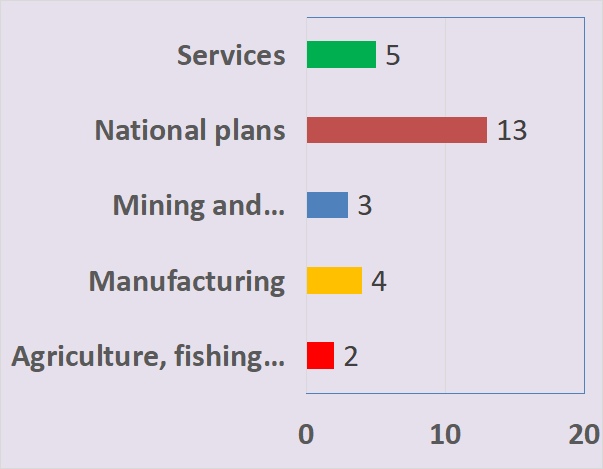
The initiation of the standard may be through industry requests by completing the standard request form, alternatively through the National Standards Plan, which is a list of priority standards identified through the National Standardisation Strategy (NSS). The NSS is a policy roadmap to provide relevant national and International Standards to support national strategic priorities. Based on the economic, social, environmental and stakeholders’ priorities. Emphasizes the effective use of resources in standards development activities. In collaboration with stakeholders, the document was developed and launched in October 2025 for 2025-2027. Focus Priority sectors include National plans, Services, Manufacturing, Mining and quarrying, Agriculture, Fisheries and Forestry
Standard types may fall in the following categories: technical specifications/ vocabulary, codes of practices or conformity assessments
- The different modes of development and optimum timelines are as follows
- Identical adoption-6 months
- Evaluation for adoption- 8 months
- Active Participation and Mirroring- 24 months
- National developmnet-14 months
- Systematic review – 12 months
The above durations are optimum; therefore, the durations may be extended or shortened on a case by case based on justifiable cause.
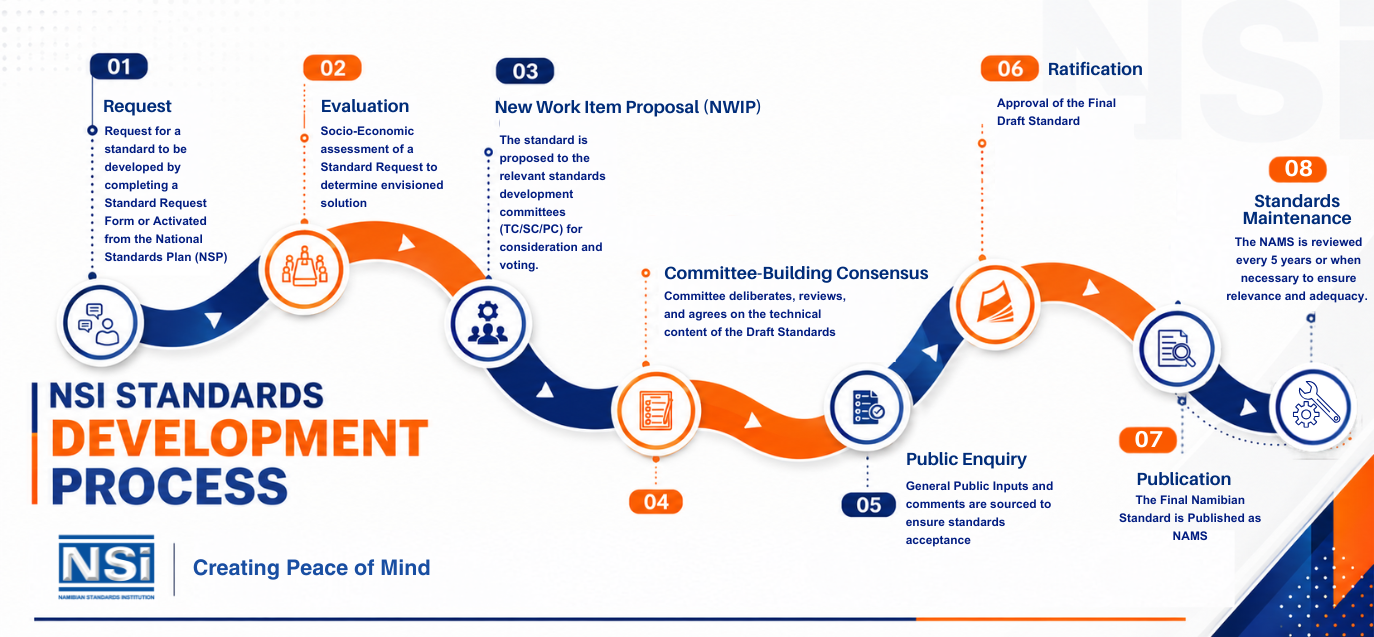
The stages of standards development are as per illustration below
Standards on Public Enquiry
As per TBT Agreement Transparency provision, the two-month public enquiry period allows interested parties to request copies, review, and comment on proposed standards that may impact trade. This process helps to maintain a predictable trading environment and reduces unnecessary trade barriers.
Below are standards on Public Enquiry for a duration of two (2) months. Click to submit comments
Be involved in Standards development
Standards are developed by the relevant standards development committees comprised of public and private stakeholders. Each committee has a Chair and Deputy Chair appointed by the committee members for a three-year term.
Stakeholders’ engagement and involvement is key to assurance of relevant and coherent standards. Thus, the NSI strongly encourages the participation of experts.
Be part of the process through standards request, providing comments and becoming a committee member. Express your interest to serve voluntarily in the NSI’s standards development committees by submitting a one pager letter accompanied by resume and qualifications for evaluation and consideration to email address ShiimbashikeR@nsi.com.na and sales@nsi.com.na
The committees also mirror and actively participate in regional, continental and international standards work of organizations such as SADCSTAN, ARSO, AFSEC and ISO. This ensures that standards are developed in a way that is inclusive and representative of the global community.
The Committee members are implored to uphold the highest level of ethics and code of conduct as per the NSI’s standards development code of conduct.
- Work for the net benefit of the country
- Uphold the consensus process
- Agree to a clear purpose and scope
- Respect others in meetings
- Participate actively
- Declare all relevant interests
- Escalate and resolve issues
- Behave ethically and legally
Standards Training
The NSI’s Standards Training Centre (STC) is the leading National Standards Trainer that leverages experienced, competent technical and professional trainers to provide world class engaging and effective national, regional, continental or international standards training to stakeholders. Our standards training services make a significant difference by enriching knowledge and experience, enhancing the implementation of standards, promoting competitive products and services, whilst streamlining operations.
The focus standards include ISO 9001-Quality Management, ISO 45001-Occupational, Health and Safety Management, ISO 22000-Food Safety Management, HACCP-Food Safety Management, ISO 14001-Environmental Management, ISO 22716-Cosmetics Good Manufacturing Practices, ISO/IEC 17025 Requirements for Calibration and Testing Laboratories as well as Pre-requisite Programmes. Refer to the Training Calendar for more information including the Terms and Conditions.
The sectors include Agriculture, Fishing, Mining, ICT, Chemicals, Food Handling, Cosmetics, Tourism, Building & Construction, Health & Medical, Transport & Logistics, Manufacturing, Educational & Academia, Banking & Financial as well as administration.
The training categories for each standard include Introduction & Awareness-Half Day, Executive Briefing-Half Day, Development & Implementation -3 to 5 Days, Internal Auditing- 3 Days, Documentation -2 Days. We also offer Integrated training for 2/3 standards (Executive Briefing/ Internal Auditing).
WTO TBT Notification and Enquiry Point
The WTO TBT (Technical Barriers to Trade) Notification and Enquiry Point is an institution established within each member of the WTO, which serves to connect and inform members, the private sector, trade officials, standards officials, regulators and any other domestic and international stakeholders, in all matters relating to the implementation of the transparency provisions of the TBT Agreement. The NSI is designated National WTO/TBT Notification Authority and Enquiry Point.
The NSI serves two primary functions:
- Notification Authority: Notify the WTO members through the WTO Secretariat of any draft measures which are either new or amended technical regulations, standards, or conformity assessment procedures that could affect international trade.
- Enquiry Point: serves as an information hub that answers reasonable questions from national and foreign stakeholders, businesses, and governments regarding national standards, technical regulations, and certification procedures.
The public can track and receive alerts about draft regulations worldwide using the official WTO ePing Platform (https://eping.wto.org/). Through the NSI, stakeholders can also formally request the full text of draft foreign regulations and submit comments to prevent unfair trade barriers.
Links to information resources:
WTO TBT information: https://www.wto.org/english/tratop_e/tbt_e/tbt_e.htm
WTO TBT Agreement: https://www.wto.org/english/res_e/booksp_e/tbt3rd_e.pdf
Receive and track trade measures: https://epingalert.org/
Video tutorials for all users: https://epingalert.org/en/Resources?info=materials
Contact Us
- Manager: Standards Publications, Sales and Information
- Ms. Lahya Hambinga
- +26461386449
- +264855602333
- hambingal@nsi.com.na
- Acting General Manager: Standards, Development and Coordination
- Ms. Rosina Shiimbashike
- +26461386432
- +264816037517
- ShiimbashikeR@nsi.com.na